Work orders, assets, PMs, a planning board and a storeroom in one system. So jobs get planned when the parts are really there, and your buyer gets the right part the first time. Quick to set up, built around your plant, with dedicated support from the people who built it.
All of this works right now in the demo. Open any of it. Nothing to install and nothing to sign up for.
From request to close-out, with checklists, parts, labor, notes, photos and failure codes.
02Drag jobs onto people and days, or plan the whole week in one click.
03By calendar or by meter, with compliance tracking and the load coming at your crew.
04The whole plant as a tree. Every machine's history, costs, spares and QR label.
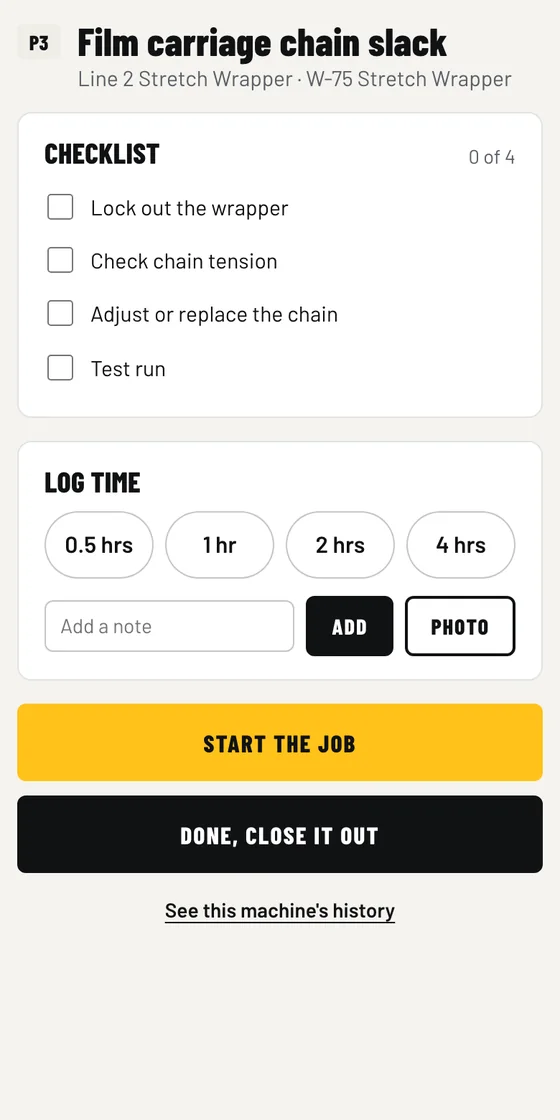
05A tech's jobs on a phone: where the parts are, the checklist, and closing out at the machine.
06Anyone can scan a machine and report a problem, with no login.
07Every low part, checked for duplicates, old counts, price jumps and open orders.
08POs by vendor, what's late, and a receipt that tells you which jobs can start.
09Search the way people talk. Abbreviations, typos and old part numbers all work.
10Count what matters first, or sweep a whole aisle in one pass.
11A score for your data, duplicates to merge, and the cash sitting on the shelf.
12Backlog, PM and schedule compliance, reactive work, and your worst machines.
Most schedules fall apart at the storeroom door. This board knows what the storeroom knows.
Your buyer is only as accurate as your system. So every line gets checked before money moves.
The book says zero. A duplicate record says five. The portal finds it, and flags a bin nobody has counted in months before you buy on a bad number.
On hand, on order and what open jobs need, in one number. No double orders, and late POs get chased instead of forgotten.
Manufacturer numbers, photos and the last price paid on every line. If a record can't support a good order, you find out before the vendor does.

Techs see today's jobs, which bin the parts are in, and the checklist. They log time, add a photo and close the job without walking back to a desk.
Anyone else can scan the QR label on a machine and report a problem in about 20 seconds, with no login. It works on the phone they already carry.
See My dayNo clean-up first and no setup. It works out what each file is and which columns matter.
A handheld reader picks up every tagged part in range, and the system shows exactly which bins don't match the book. We start with one aisle, so you can see whether it's worth it before you tag anything else.
See how it worksYour plant doesn't run like a template. We start from this system and fit it to your assets, your part numbers and how your team works. Fixed scope and fixed price, agreed before work starts.
Pick the parts, the workflows and the finish line.
Scope + fixed priceNames, numbers, duplicates and gaps resolved.
Clean part dataAssets, PMs and work orders loaded, screens fit to your team, scanners and labels set up.
A system your team usesTrain the team, write it down, and stay on for the fixes.
+ 30 days of fixesThe same part entered four ways, no photo, no bin. Techs stop trusting the system and walk the aisles while the line waits.
Want to see it on your own records first? Send about 100 part records and we'll send them back cleaned up, free. No call needed to get started.
Book the free checkGrowing plants don't have time to learn storeroom design the hard way. We plan the layout, the bin map, the stocking list and the labels, with every fastener and fitting in order. You build it from our plan, or we set it up for you.
CMMS, ERP, spreadsheets, label printers, Teams and Slack alerts, plant-floor data. Exports to start, APIs when you're ready.
Logos show compatibility, not partnership. Trademarks belong to their owners.
See all integrationsFinal scope depends on plant size and data condition. You see the deliverable and fixed price before anything is billed.
We've walked the aisles looking for parts the system swore were there. So we built the fix.
Storeroom Fix is run by a working plant MRO storeroom tech who builds maintenance software. The goal is simple: make the people keeping your plant running faster and more accurate, with software that fits how it actually runs.
You talk to the people doing the work.
Yes: work orders, assets, PMs, a planning board, requests, a phone view for techs, a storeroom with purchasing, receiving and counts, and KPIs. You can use all of it right now in the demo. The free version runs in one browser. A rollout puts it on a server for your whole crew, with logins and backups.
Yes. The demo plant and Try With Your Own Data are free, with no signup and no credit card. What you load stays in your browser, so it's only for you. Sharing it with your team, connecting it to other systems and support are the paid part.
No. Your browser reads the files on your computer. That page has no analytics, and its security rules block uploads. Photos come from one shared image file, so loading them says nothing about your parts.
No. It can replace it, or sit next to it and do the jobs yours does badly, like planning and purchasing. Anything that exports to Excel or CSV works: eMaint, Fiix, MaintainX, UpKeep, Limble, Maximo, SAP PM, Infor EAM or a plain spreadsheet. Systems with an API can be connected directly. See integrations.
We keep a library of catalog photos, matched by manufacturer part number or model. It covers a couple hundred common parts today, so expect gaps. A match is labeled as a catalog or typical photo, so check it against the real part. You can also add your own photo to any part.
Not to try it. A rollout starts from exports too. Anything that writes back to your current system happens with access you control, and only after you approve it.
You work with the people who built your system. Fixes, new parts added to your standard, small improvements and a monthly data health check, from $1,500 a month.
We plan on about 30 days for a plant with a few thousand parts. Scope and price are fixed before work starts.
Yes. Send about 100 part records and we'll send them back free: standard names, manufacturer numbers filled in where they can be found, duplicates flagged and a short report of what's missing. A full cleanup is part of a rollout, or quoted on its own.
Yes: tags, labels, handheld readers and the software that compares a sweep with your book. We start with one aisle so you can see whether it's worth it. How it works
Software and data work is remote, anywhere in the US. On-site storeroom work like bin locations, labels and photos is available around Columbus and central Ohio.
A manufacturing plant MRO storeroom technician who builds maintenance software. Storeroom Fix is a service of Trago LLC, an Ohio company.
30 minutes, by phone or video, with the people who do the work.
No good time? Email hello@trago.io and we'll work around you.